Revisit Claes Oldenburg’s Seminal ‘Six Themes’ 50 Years After Its Debut
Claes Oldenburg’s (1929-2022) most famous piece of writing is his statement titled “I Am For…” which graced an exhibition catalogue in 1961 and starts:
I am for an art that is political-erotical-mystical, that does something other than sit on its ass in a museum. / I am for an art that grows up not knowing it is art at all, an art given the chance of having a starting point of zero. / I am for an art that embroils itself with the everyday crap and still comes out on top. / I am for an art that imitates the human, that is comic, if necessary, or violent, or whatever is necessary. / I am for all art that takes its form from the lines of life itself, that twists and extends and accumulates and spits and drips, and is heavy and coarse and blunt and sweet and stupid as life itself.
In all, the statement runs about 700 words. The piece is worth reading all the way through, especially for anyone stuck at a creative impasse, as Oldenburg later described it as a “slightly satirical ode or paean to the possibilities of using anything in one’s surroundings (mostly urban) as a starting point for art.” “I Am For…” is often described as a manifesto, although the artist insisted it was not. I happen to have the last line quoted above tattooed on my arm anyway.
Claes Oldenburg’s large-scale installations are iconic, typically taking everyday items and tools and ramping them up to a monumental size. Perhaps the most famous, “Spoonbridge and Cherry” (1988), was made in collaboration with his wife and fellow artist Coosje van Bruggen and has pride of place over a pond in the Minneapolis Sculpture Garden. At the entrance of the Denver Art Museum, “Big Sweep” (2006) depicts a broom whisking crumpled paper into a dust pan. And in the Sculpture Garden of the National Gallery of Art in Washington, D.C., “Typewriter Eraser, Scale X” (1998-99) depicts a giant vintage eraser with a small attached brush used to manually edit typewritten texts.
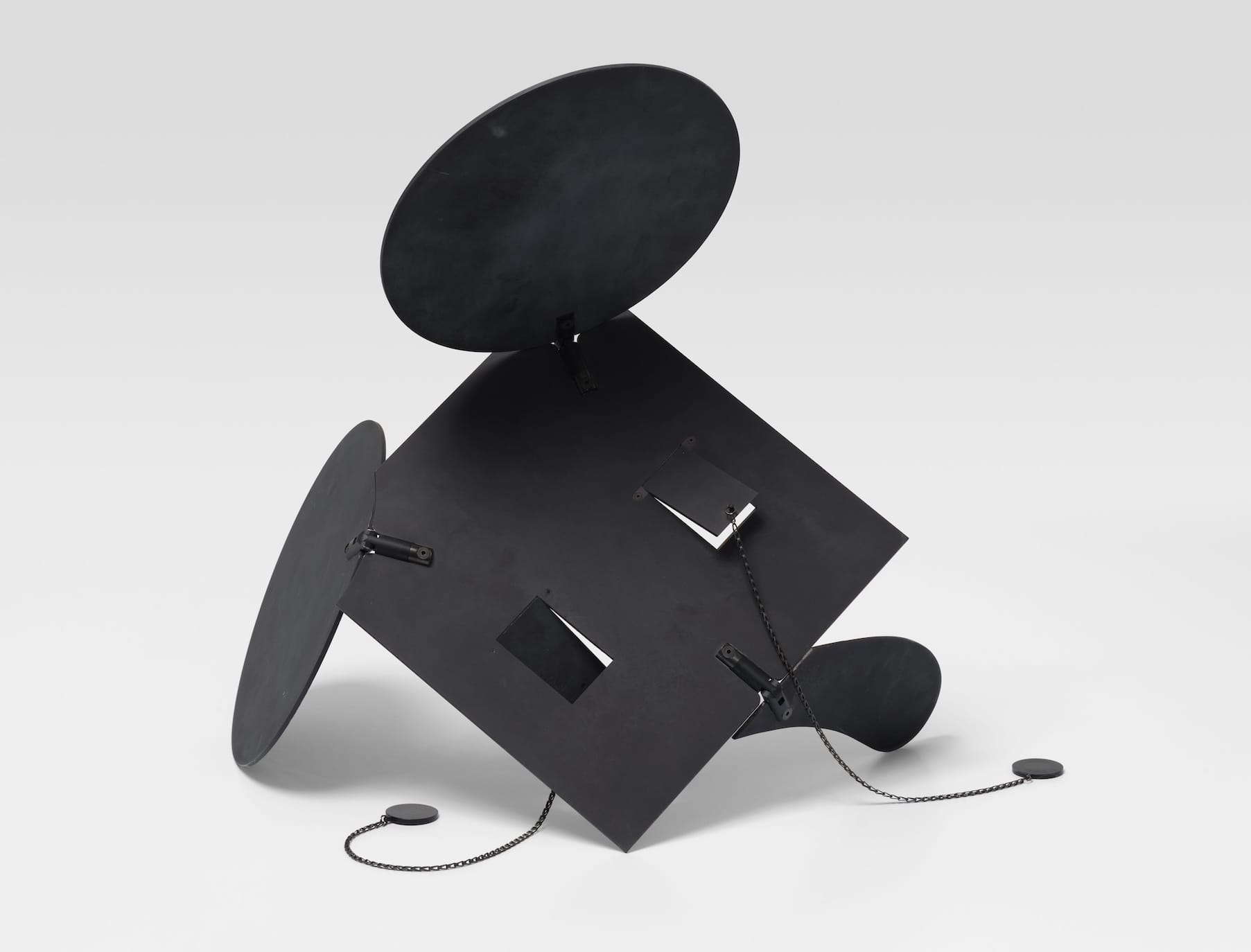
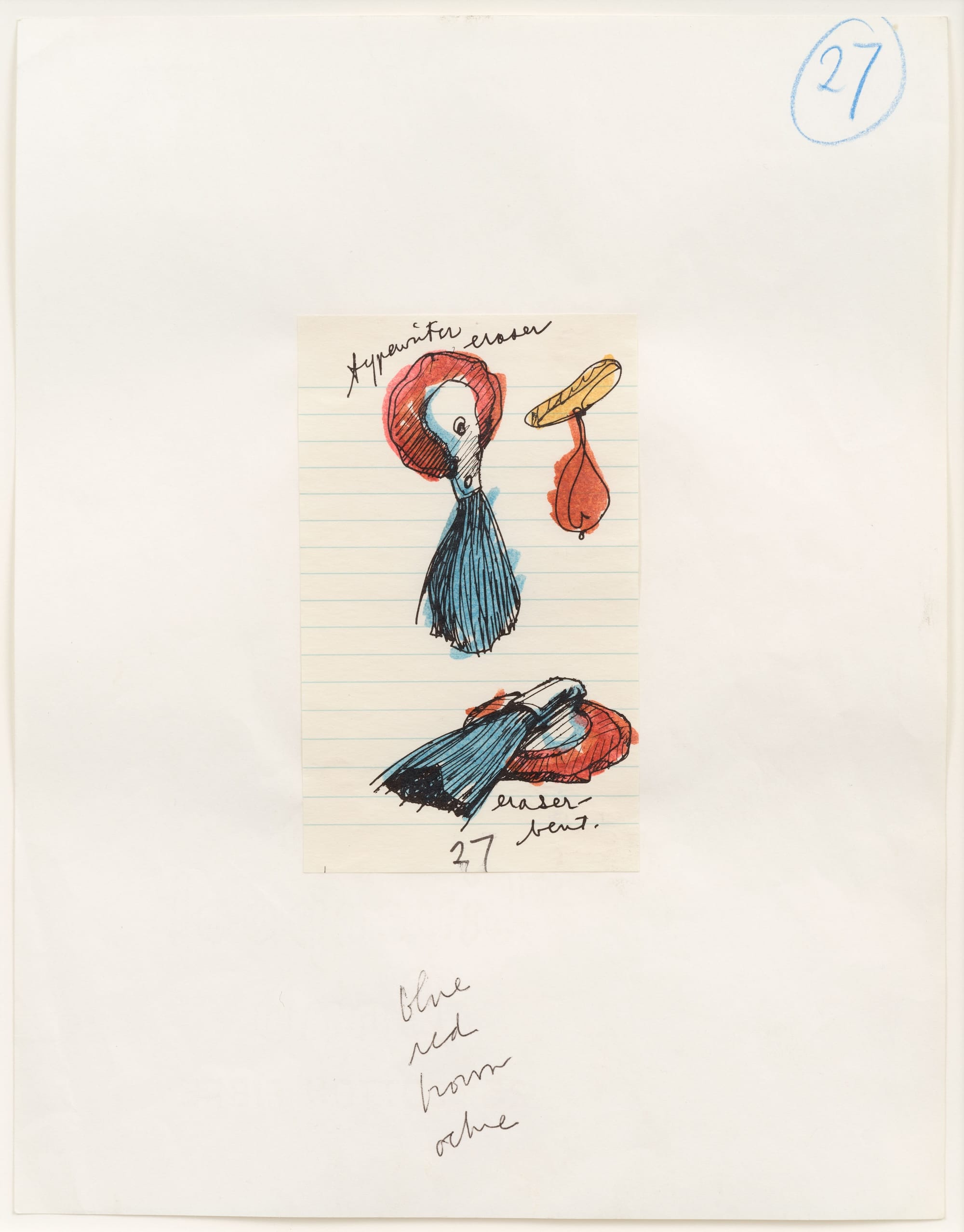
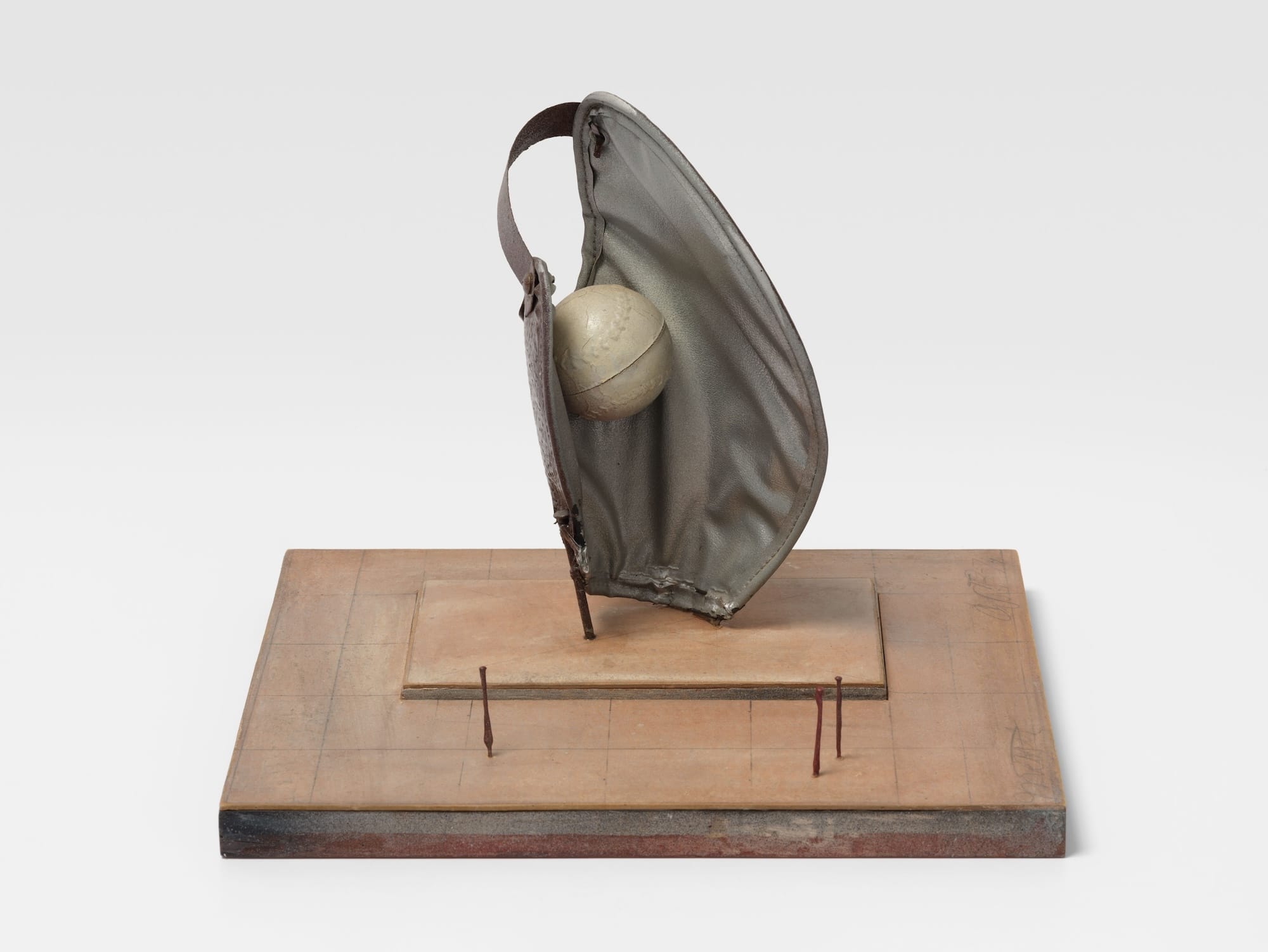
The latter motif is also one of Oldenburg’s “Six Themes,” explored in-depth from the 1970s onward. These subjects, which spurred myriad artworks apiece, consist of Geometric Mouse, Three-Way Plug, Fagends, Clothespin, Typewriter Eraser, and Standing Mitt with Ball. Sketches and material explorations prompted numerous interpretations of these seemingly mundane objects.
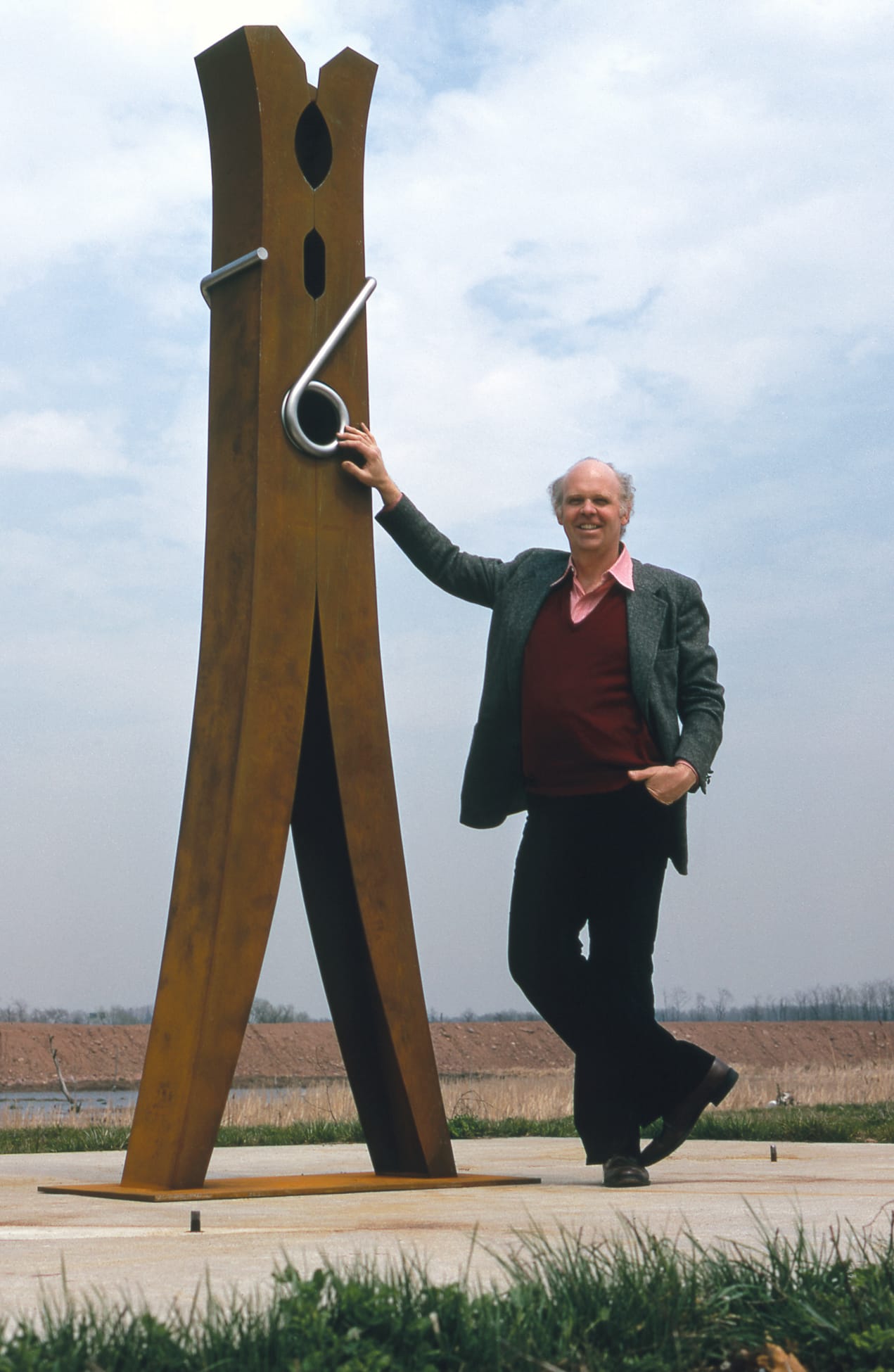
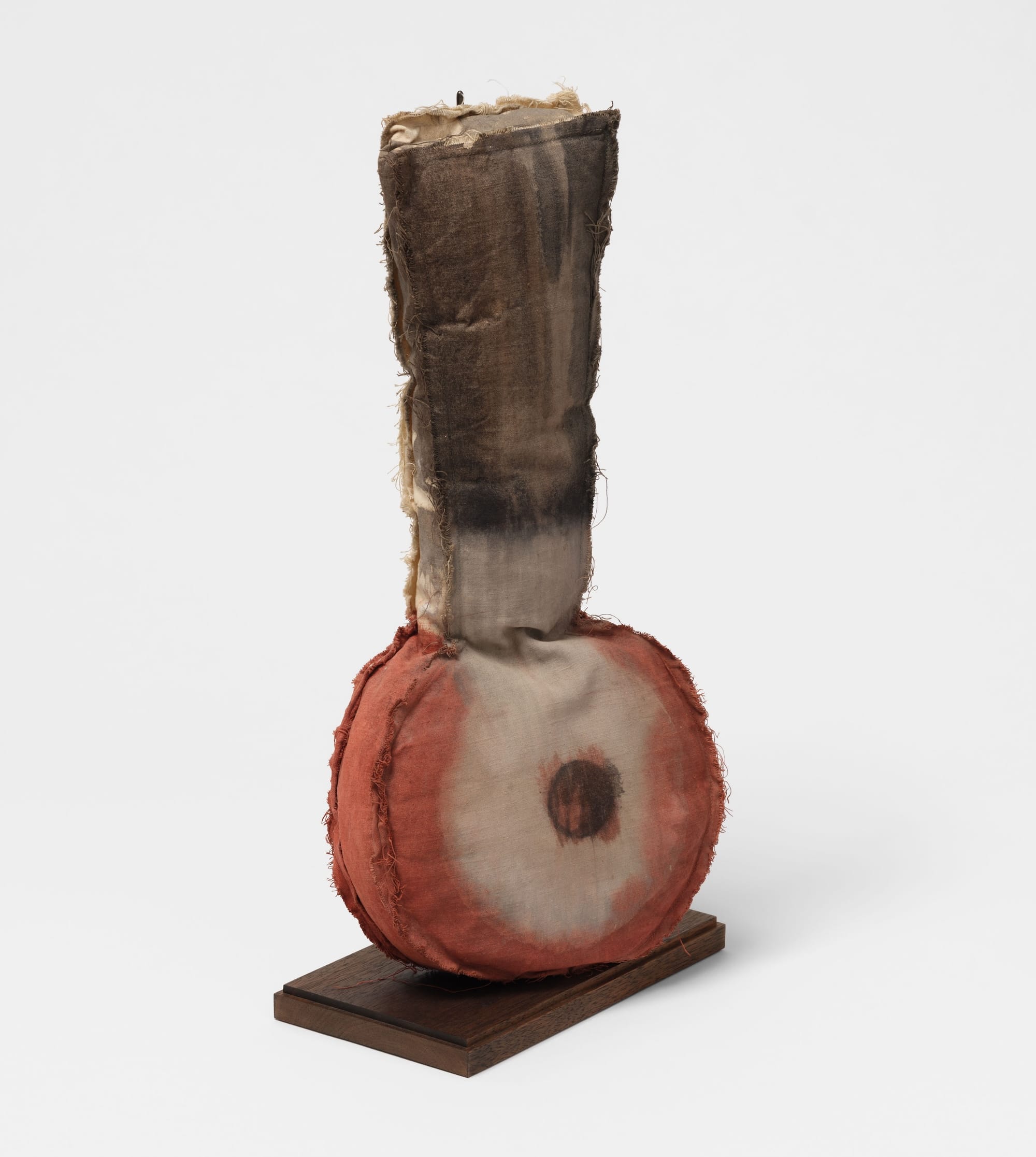
Oldenburg scaled up the clothespin, for example, so it stood like a giant figure, and he also produced soft prototypes made of stuffed, sewn canvas. He said that “a requirement of any subject is that it be extremely adaptable, especially in scale, so that a small clothespin would be as interesting as a clothespin a hundred feet high.”
The artist was also sensitive to objects’ potential for dynamism where we might not expect it. In “Typewriter Eraser, Scale X,” the round rubber wheel appears to careen across the lawn, its bristles getting blown back in the wind. (The first time I saw one of the Typewriter Eraser works, I thought it was meant to be a wheel that had absconded from its vehicle.)
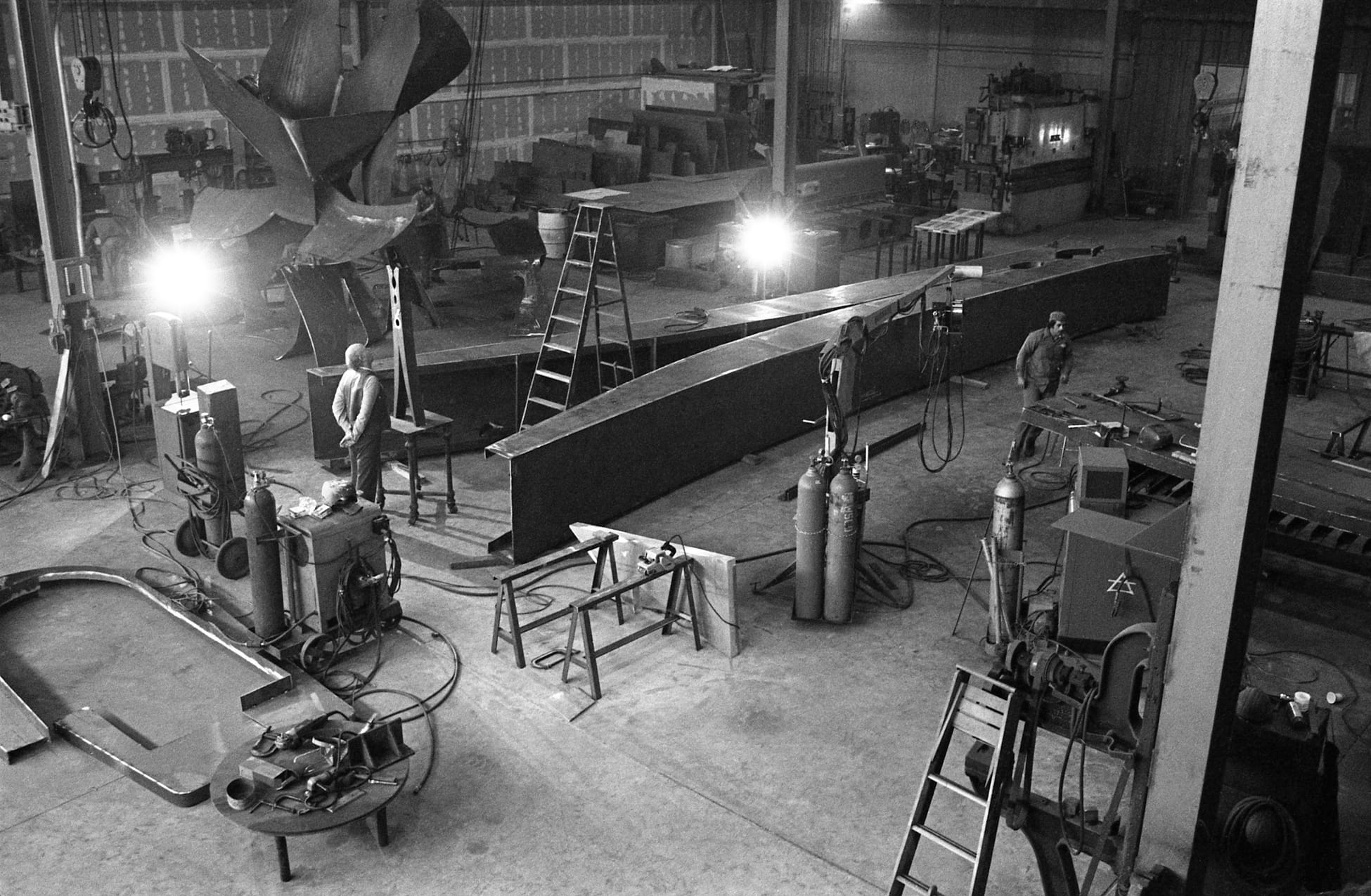
Oldenburg privileged re-creating objects rather than utilizing found examples, so although they have a readymade-like quality, they’re anything but. He studied his source material from every angle, working with a team to fabricate giant installations that retain the familiarity of the original but challenge viewers to see them afresh. Over time, as some of the original objects have become obsolete—namely the typewriter eraser and the movie film projector, the profile view of which inspired the Geometric Mouse works—they’ve assumed an unintentional abstraction.
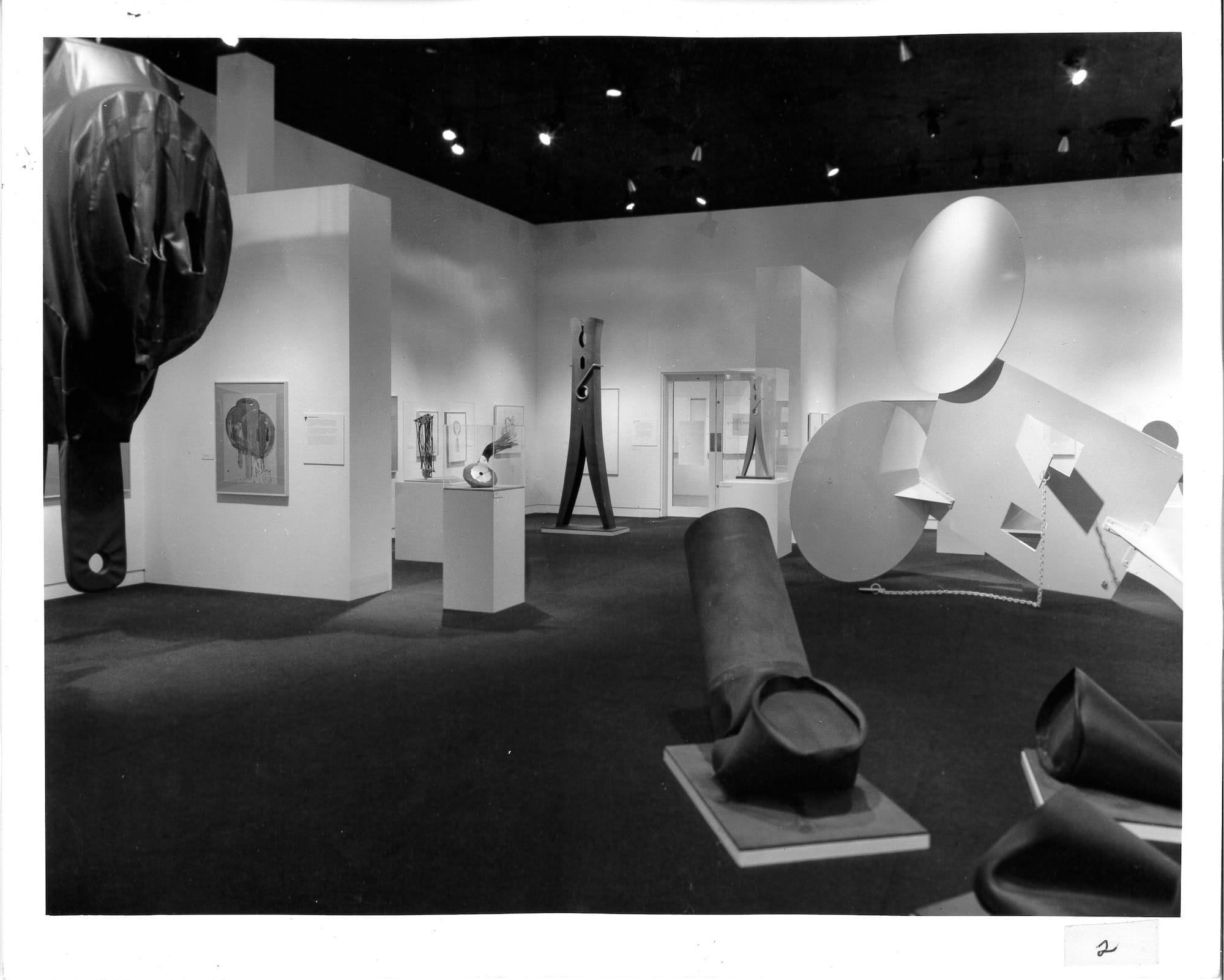
Several sculptures from the series go on view next month at Paula Cooper Gallery in the aptly titled Six Themes, which in turn takes its name from the landmark survey exhibition staged at the Walker Art Center in 1975. Afterward, the show traveled to the Denver Art Museum, Seattle Art Museum, New Orleans Museum of Art, and the Art Gallery of Ontario, Toronto.
The new Six Themes is an ode to Oldenburg’s seminal pieces that have not been celebrated collectively since they were first shown 50 years ago. The exhibition includes significant works representing each of the half dozen subjects, including rarely seen examples from the artist’s estate and private collections. The show opens on November 5 and continues through December 19 in New York.

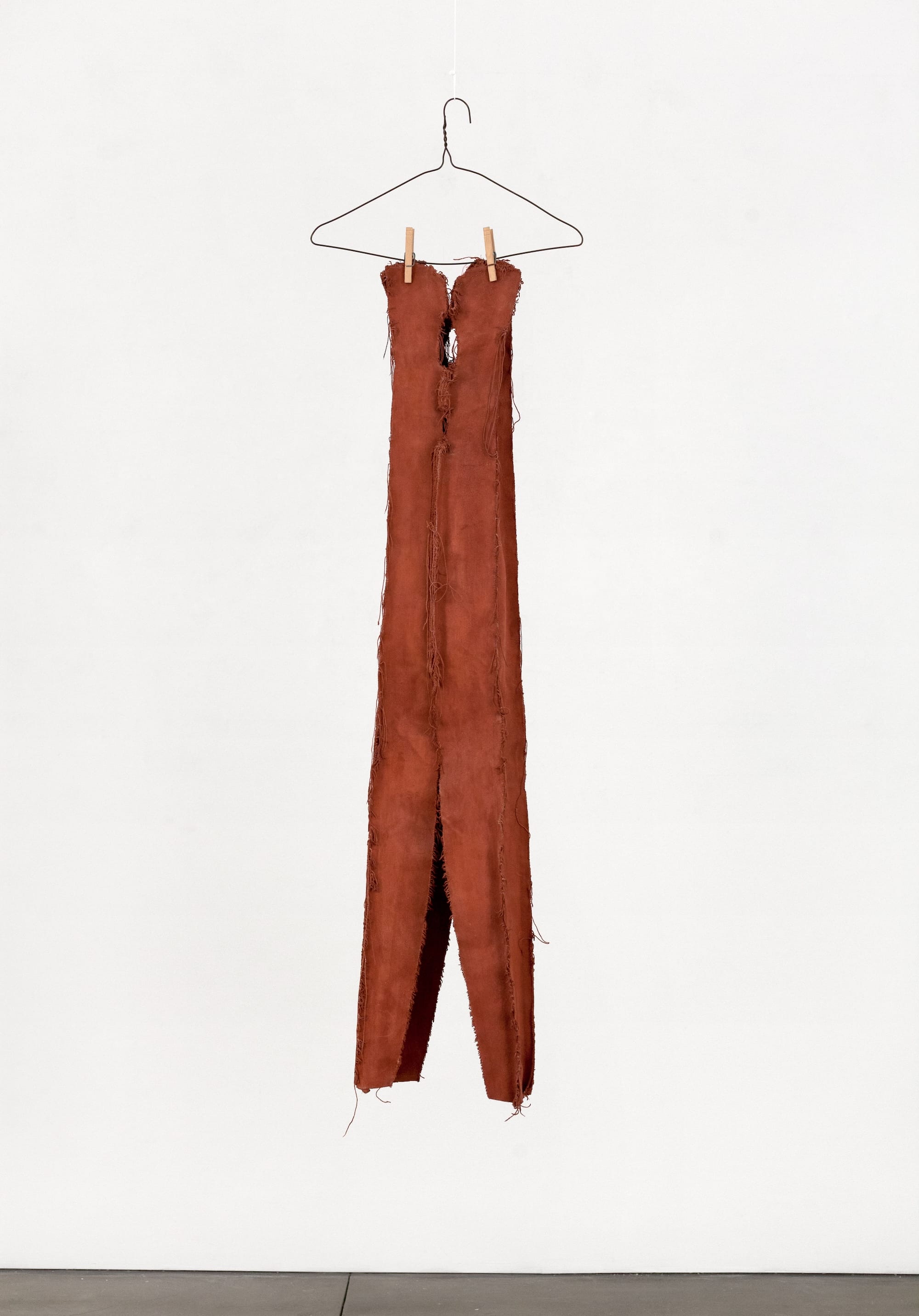
metal hanger and wooden clothespins, 56 1/2 x 16 x 4 inches. Photo by Steven Probert Studio
Do stories and artists like this matter to you? Become a Colossal Member today and support independent arts publishing for as little as $7 per month. The article Revisit Claes Oldenburg’s Seminal ‘Six Themes’ 50 Years After Its Debut appeared first on Colossal.